By Kurt Overhardt and Brian Schoelzel
In the midst of a global pandemic, there are concerns far more serious than the paychecks of professional athletes and the balance sheets of team’s owners. This piece is not intended to be insensitive to those that are hurting economically or especially to those that have lost loved ones, but instead is meant to shed light onto a business issue that is facing the National Hockey League (NHL).
When the NHL suspended play on March 12th due to the Coronavirus pandemic, the League made the responsible decision to help protect the general public despite knowing that it would be detrimental to its financial health. While the extent of this damage is yet to be determined, a complete cancellation of the season could cost the League upwards of a billion dollars in Hockey Related Revenue (HRR). Cancelling the remainder of the 2019-20 season would be devastating for NHL owners, players and fans, but regardless of when hockey resumes, there is a lot to be optimistic about for the future of the League.
In January, the NHL’s most credible source on business operations, Commissioner Gary Bettman, told The Athletic, “I think the business of the NHL has never been stronger. We continue year after year to set records revenue-wise. If not setting an attendance record, we’re playing basically to 95 percent of capacity in the regular season and over 100 percent in the playoffs. Business has never been stronger, which is a testament to the state of the game; to the strength of our franchises and ownership, which has never been better; to our extraordinary competitive balance.” (1)
This sentiment is further demonstrated by the Forbes’ 2020 Business of Hockey Report which reveals that the average value for an NHL franchise has passed the $666,000,000 mark and is growing at an average annual appreciation rate of about 6.26%. (2)
Despite the financial damage resulting from COVID-19, there is still strong reason to believe that these valuations will continue to climb in the next 36 months and every year thereafter as the League introduces its 32nd franchise in Seattle and negotiates new television and media deals.
The League will also greatly benefit from the legalization on a state-by-state basis of sports gambling. There is much to be optimistic about as these new and existing revenue sources will continue to enhance the value of each NHL franchise. Additionally, franchise values should grow exponentially once the League and the NHL Players Association (NHLPA) agree on a new Collective Bargaining Agreement (CBA).
However, despite this tremendous amount of growth, the players are still suffering from an unequal revenue split between the NHLPA and ownership. In 2012 under new NHLPA leadership, the players lost ground as they saw their share of Hockey Related Revenue dwindle from 57% down to 50%. (3)
While this 50-50 split may seem equitable on the surface, in reality, the 50% players’ share is illusory when considering the fact that 100% of the following costs are deducted from the players’ 50% share each season:
1. Employer Tax
2. Medical, Dental, Life and Disability Insurance
3. Player Pensions, Includes Defined Benefit Pension Plans
4. Player Buy-Outs
5. Long-Term Injury Contracts
6. Workers Compensation Insurance
7. Player Playoff Share
Bearing the above costs equates to approximately 6% of the players’ 50% share, thus reducing their split to an inexplicable 44% (4). The NHL CBA not only provides owners cost containment through a multi-cap system (hard team salary cap, hard league-wide salary cap, rookie salary cap and individual contract cap), these seven expenses represent a significant transfer of costs, most of which are typically the employer’s responsibility. NHL ownership has also benefitted by not having certain revenue sources included in HRR including expansion fees. Meaning that the Seattle franchise’s incoming expansion fee will have zero impact on reducing escrow, and the owners will exclusively capture the entire $650 Million. Just as they pocketed the $500 Million from Vegas’s entry into the League in 2017.
Additionally, if the NHL does not hit its projected HRR each season, player compensation is reduced pro rata in accordance with an escrow provision set forth in the CBA. Since 2012 the average escrow per season has been approximately 11.47% which results in players only receiving 88.53% of their negotiated compensation (5). As a consequence of the potential economic impact surrounding COVID-19, the League and ownership could argue that NHL players see more than 40% of their paychecks being escrowed in the 2020-21 season.
Escrow is a complex issue and although it is at the center of the ongoing CBA negotiations, it will be a challenge getting ownership to agree to take back any of the seven business expenses that are contributing to this inequitable split or agree to cap the percentage of escrow that can be deducted – even though both are reasonable solutions moving forward.
However, there is a practical solution for reducing escrow while simultaneously increasing the competitive landscape of the League: The Exception Player Rule.
Under this new system, each Club would be allowed to designate one Exception Player whose compensation would be excluded from the team’s salary cap considerations as well as the players’ share of the revenue split. The benefits of this system extend far past the Exception Player as an individual as there would now be more money in the pool available for his teammates.
Competition among the League’s 31 owners is fierce with each Club constantly looking for any angle to gain a competitive advantage. This system also represents a win for NHL owners as they are provided a strategic mechanism in which they can fight for the League’s top players. Exception Players could be obtained via the Draft, trade or free agency, thus heightening the competition amongst owners for the League’s super elite. Players would eligible for the designation upon the expiration of their Entry-Level Contract.
This would be an opt-in system and choosing to use the designation would be 100% at the discretion of each Club. There would be no minimum payment threshold to qualify for the designation and only allowing one Exception Player per team would avoid bias towards the richer organizations. The broad diversity of NHL markets and players’ idiosyncrasies would enable each Club to attract and retain its own super elite player over time.
Even in the event that a small-market team pushes back against the Exception Player rule, the League could require that any Club that designates and signs an Exception Player pay a luxury tax which would then be distributed to the Clubs that have not made such a designation.
When taking into consideration all of the unparalleled goodwill that players such as Sidney Crosby and Alexander Ovechkin have provided the League, their fellow players and the sport as a whole, they are clearly some of the most underpaid athletes in the world. The top NHL salaries pale in comparison to those found in the MLB, NBA and NFL.
The NHL ranks fourth among the major leagues in average franchise value and therefore no one is suggesting that NHL players be paid the astronomical salaries that are becoming common in other sports. However, the other three leagues have increased superstar players’ salaries at a rate that much more accurately mirror their respective league’s growth. The following charts show how franchise values and top players’ salaries have grown over the past twenty years. (6) & (7)
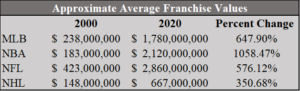
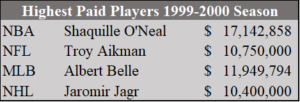
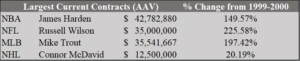
As you can see, the NHL’s top salary has only increased by 20.19% despite over 350% growth in franchise values. The ratio between these numbers equals 5.76% which is tiny in comparison to the 14.13% (NBA), 39.16% (NFL) and 30.47% (MLB) achieved by the other leagues.
The NBA, MLB and NFL have increased in popularity by effectively showcasing their super elite players and rewarding them with salaries that fairly reflect their contribution to their league. The NHL’s growth can also largely be attributed to the rise of young, superstar players and therefore they deserve to take a larger cut in the value that they are helping create. The Exception Player scenario would enable these super elite players to be compensated at a level that more accurately represents their contribution to the League without penalizing their teammates.
Ironically, one of the biggest hurdles in introducing the Exception Player Rule will be getting approval from the players themselves. As Ken Campbell stated in the 2020 Superstar Issue of the Hockey News, “Hockey Players refuse to be selfish – to a fault. (8)” Hockey players are extremely humble and many of them subscribe to hockey’s culture of putting the team ahead of their own interests by refusing to bring any additional attention to themselves. For example, NHL superstar Nathan MacKinnon is widely considered to have the biggest bargain of a contract in the League. When asked about his upcoming contract, MacKinnon said, “We have guys that we wouldn’t (otherwise) be able to bring in. On my next deal, I’ll take less again because I want to win with this group. (9)” MacKinnon’s quote exemplifies a sacrifice that superstars from other leagues don’t have to make: take less than what you’re worth, or the team will suffer.
Because of hockey’s culture and the dilemma forced upon the super elite, players may be reluctant to sign a contract that in some instances would pay them twice as much as their closest teammate. What they neglect to realize is that accepting the designation is arguably the most selfless thing they can do. By removing their salary from cap considerations, it leaves more money in the pool for their teammates and allows Clubs the ability to sign additional players that make the team more competitive.
There is no denying that this pandemic will take its toll on the economy, but over time the sports and entertainment world will continue to grow and prosper. As we return to normalcy, people will look to sports more than ever before to regain the sense of community and identity that they derive from rooting for their favorite teams and players. Because of this, there will be a unique opportunity for the League and Players Association to work together toward a CBA that intelligently and equitably mitigates both the COVID-19 related economic issues and the issue of player escrow that has plagued the League since 2005.
During the ongoing CBA negotiations, on behalf of its player membership, the NHLPA needs to identify ways that it can effectively combat escrow and realize a more equitable split in HRR. While clawing back any of the seven costs will be challenging, creative solutions such as The Exception Player model represent a win for both the players and the owners by increasing the amount of money available under the salary cap while also increasing the competitive landscape of the League.
Kurt Overhardt is the Founder & CEO of KO Sports, Inc. and has been representing NHL players since 1992. Mr. Overhardt does not represent the players mentioned in the article including Alexander Ovechkin, Sidney Crosby or Nathan MacKinnon.
Brian Schoelzel is an associate at KO Sports, Inc. and is completing his MBA at the University of Denver.
—————————————————————————————————————————————————————————————————————————–
Sources
1 https://theathletic.com/1498264/2020/01/02/2020-predictions-and-thoughts-from-sports-industry-figures/
2 https://www.forbes.com/nhl-valuations/list/
3 There’s No I in Money by Ken Campbell. The Hockey News Superstar Issue 2020 Page 82
4 National Hockey League Collective Bargaining Agreement Section 50.3
5 https://23ar1d2enysp3irtdn2q9nyk-wpengine.netdna-ssl.com/wp-content/uploads/2018/11/NHL-Escrow-Update.pdf
6 https://www.statista.com/statistics/193435/average-franchise-value-in-the-nfl-since-2000/
https://www.statista.com/statistics/193441/average-franchise-value-in-mlb-since-2000/
https://www.statista.com/statistics/193443/average-franchise-value-nhl/
https://www.statista.com/statistics/193442/average-franchise-value-in-the-nba-since-2000/
7 There’s No I in Money by Ken Campbell. The Hockey News Superstar Issue 2020 Page 82
https://www.spotrac.com/nba/rankings/average
https://www.spotrac.com/nfl/rankings/average/
https://www.spotrac.com/nhl/rankings/average/
8 There’s No I in Money by Ken Campbell. The Hockey News Superstar Issue 2020 Page 82
9 https://www.forbes.com/sites/jordanhorrobin/2019/12/05/nathan-mackinnon-contract-underpaid-team-friendly-nhl-colorado-avalanche-shifting-rfa-market/#4d8407515c03